

If you are like me, you are likely very fatigued from all the keyboard lawyers this week regarding the use of deadly force by an ICE Officer in Minneapolis. There’s no stopping the unhinged citizens and the political hacks from doing what they do, but it has been particularly disturbing to see law enforcement leaders weigh in with an absolute opinion based on internet videos.
They have been burned so much in the past, you’d think they would wait for additional information, but the attention is all too seeking for that.
Any expert in the use of force will not have an opinion until they have all the facts in this case, and that is frustrating because it leaves us with a bunch of talking heads who don’t know much.
In general terms, keep this in mind.
The constitutional standard for the use of force is clear (Graham v. Connor, 1989).
The officer must be judged on what they knew at the time.
Hindsight bias is rejected. Facts that become known after the fact play no role in deciding the reasonableness of the force (everyone is judging based on this).
Courts must account for the reality that officers often make split-second decisions in tense, uncertain, rapidly evolving situations.
The objective reasonableness analysis is based on the totality of the circumstances, including the severity of the crime, the immediacy of the threat, and whether the suspect was actively resisting or attempting to flee, among other factors.
The intent of the officer or the suspect does not play a role in reasonableness.
It’s appropriate to discuss these general facts when asked about this case, but oddly, few want to hear this, and almost no one is saying it.
Facts May Not Matter
I’d like to think that facts will matter here, but when politicians call it murder after watching a video, we know what typically happens next. This brings me to a more pressing issue, and one that has been ignored for a long time.
Minnesota has the most dangerous use-of-force standard for officers in the country, and I’ve been speaking about it since it was adopted post-2020. The rewrite of Minnesota Statute. § 609.066 added a three-part “threat” test for deadly force, and buried in that test is a sentence fragment that sounds harmless in a committee room but becomes the method for throwing cops in prison for following the constitutional standard for force.
Deadly force is authorized if it is “reasonably likely to occur absent action by the law enforcement officer.”
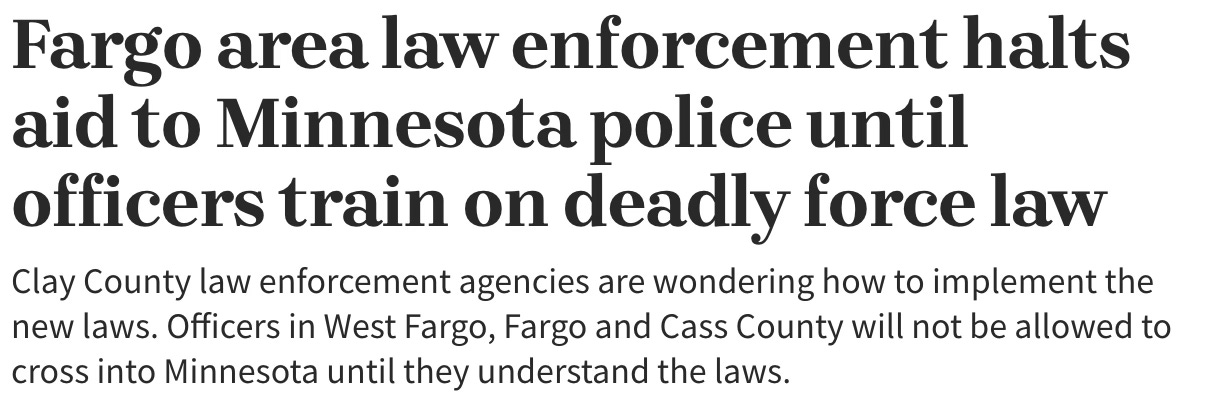
You may ask yourself what that means, and that is exactly what Minnesota cops did when it was passed without an answer. That was enough for leaders in North Dakota to announce that they will no longer permit their officers to cross the border to help Minnesota officers in need.
This language, added to what was a Graham-based law, changes the legal question from “Was this force objectively reasonable?” to “Would the danger still have been likely if the officer had done something different or nothing at all?”
It can be taken to the extreme, which is what Minnesota leaders have been doing for years:
If the officer had not pulled over the car, they would not have been forced to use deadly force when the suspect pointed a gun at them. After all, the suspect would not have pointed a gun if the officer had not stopped them.
Remember, as the law is written, the deadly force was likely to occur “absent action” by the officer…Meaning the suspect would have risked the lives of those around him/her even if officers were not present.
It sounds crazy, but this is Minnesota, and this is why I called on every Minneapolis officer to flee their agency a few years ago. The writing wasn’t on the wall…it was in their policy manual.
Imagine working under the Hennepin County Prosecutor as a police officer with that language in the statute?
“You could have waited.”
“You could have backed up.”
“You could have de-escalated.”
“You could have ignored it.”
Being accused of that and more isn’t just a policy violation…it’s Minnesota State Law.
What’s Next
It’s obvious what the politicians in Minnesota have planned. They will indict a federal officer based on this statute, which was always designed for a time such as this. Granted, the Supremacy Clause of the United States Constitution would likely remand the case to a federal judge, who will, in all likelihood, compare the “gotcha” state law to the actual constitutional standard and laugh it out of court, but it will give Minnesota politicians and misinformed citizens exactly what they want.
Another reason to scream and yell.
Dr. Travis Yates retired as a commander with a large municipal police department after 30 years of service. He is the author of “The Courageous Police Leader: A Survival Guide for Combating Cowards, Chaos & Lies.” His risk management and leadership seminars have been taught to thousands of professionals worldwide. He is a graduate of the FBI National Academy with a Doctorate Degree in Strategic Leadership and the CEO of the Courageous Police Leadership Alliance.
Another amazing article and the perspective we can't get anywhere else. Every state in the 1790s agreed to Article VI and the supremacy clause.
I have a question regarding the totality of a given situation.
Does the fact that the officers were knowingly in a hostile environment with no backup from local PD (not putting this on rank-and-file) and reportedly being stalked play a role in the court's decision? How about the fact that officers are undoubtedly aware that vehicles are increasingly being used to target law enforcement? This officer was in fact, dragged by a vehicle in the past.
Thanks, I'm still learning.