

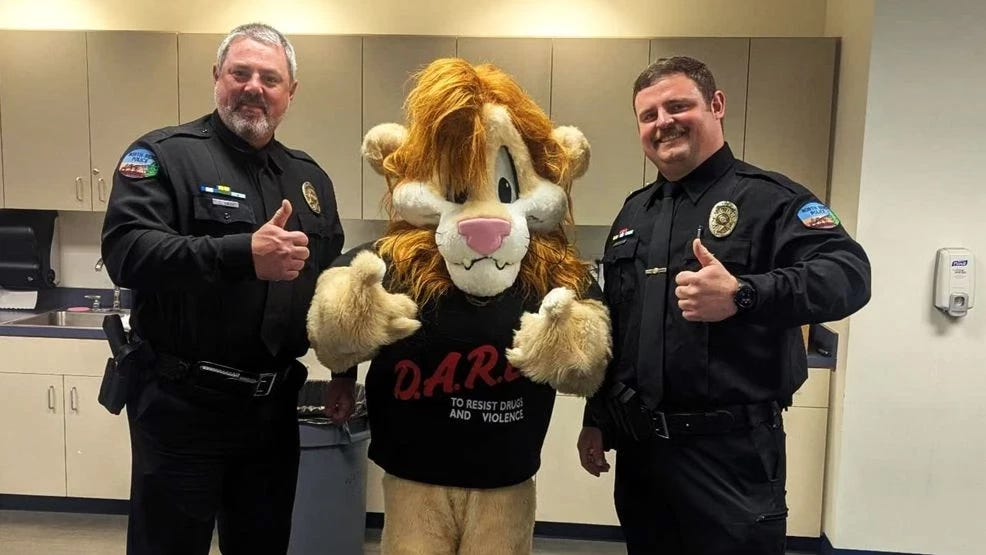
In the 1980s, America fell in love with a program. Uniformed police officers entered elementary school classrooms across the country, preaching the dangers of drugs to wide-eyed children. Parents loved it, and the politicians funded it. By the 1990s, D.A.R.E. — Drug Abuse Resistance Education — had reached roughly 75 percent of all U.S. school districts and was consuming hundreds of millions of taxpayer dollars annually.
There was just one problem: it didn’t work. Worse, evidence emerged that it may have made things worse.
In 1998, D.A.R.E. was still a sacred cow within law enforcement, with many agencies dedicating full-time officers to the program. When I wrote my master’s thesis on the scam, it hurt feelings, and what I will be saying today and in the next few articles about de-escalation will do more than that.
But I am writing it for one reason. Just like D.A.R.E., lives are being endangered while leaders are being fooled by political pressure with millions of dollars at stake.
The D.A.R.E. Blueprint: Popularity Over Proof
D.A.R.E. launched in 1983 as a collaboration between the Los Angeles Police Department and the Los Angeles Unified School District. Its premise was intuitive and appealing: put a trusted officer in the classroom, educate children about the harms of drugs, and reduce future drug use. The logic was right, and the optics were even better.
What followed was one of the most significant case studies in the failure of evidence-free policy scaling. As early as 1992, a study at Indiana University found that D.A.R.E. graduates actually showed *higher* rates of hallucinogenic drug use than students who never participated in the program, a result researchers partially attributed to the program introducing younger children to substances they hadn’t previously known existed. A six-year peer-reviewed study tracking students from 1989 to 1996 found that suburban D.A.R.E. participants reported 3 to 5 percent higher rates of drug use than non-participants across multiple categories, including alcohol, marijuana, hallucinogens, cocaine, and tobacco.
The Research Triangle Institute concluded that D.A.R.E. was less effective than alternative approaches in every measured category, drug knowledge, attitudes, social skills, and actual drug use behavior. The National Institute of Justice reached the same conclusion in 1998. The California Legislative Analyst’s Office followed in 2000. Study after study, across methodologies and jurisdictions, returned the same verdict: the program failed, and in some contexts, backfired.
What was D.A.R.E.’s response to this accumulating scientific consensus? Denial. Program leadership dismissed peer-reviewed findings as “bogus,” “academic fraud,” and “voodoo science,” alleging that critics were financially motivated and “misusing science.” Rather than engaging with the evidence, the organization attacked the researchers. Meanwhile, federal dollars continued to flow, school districts continued to implement the program, and a generation of children passed through a curriculum that produced more drug use and more lives lost.
The De-escalation Movement: Déjà Vu in a Different Uniform
De-escalation is not a new concept, and various examples, including Verbal Judo, can be traced back decades, but in the 2010s, something shifted. On the heels of legal and justified shootings such as Ferguson, major police organizations began talking about de-escalation not as a tool or a tactic, but as a way to build trust between the police and the community.
It began in 2015 with the Final Report of the President's Task Force on 21st Century Policing. While not defined, Pillar 2 of that document said that "Law enforcement agency policies for training on use of force should emphasize de-escalation and alternatives to arrest or summons in situations where appropriate." While this was general enough to allow for interpretation for leaders, it would soon become the policy foundation for a national training mandate.
Just a year later, the PERF Guiding Principles on Use of Force adopted de-escalation as a formal agency policy, making it clear that de-escalation is the preferred, tactically sound approach in critical incidents. Not only did it mandate policies and training, but it also imposed accountability on officers who failed to de-escalate.
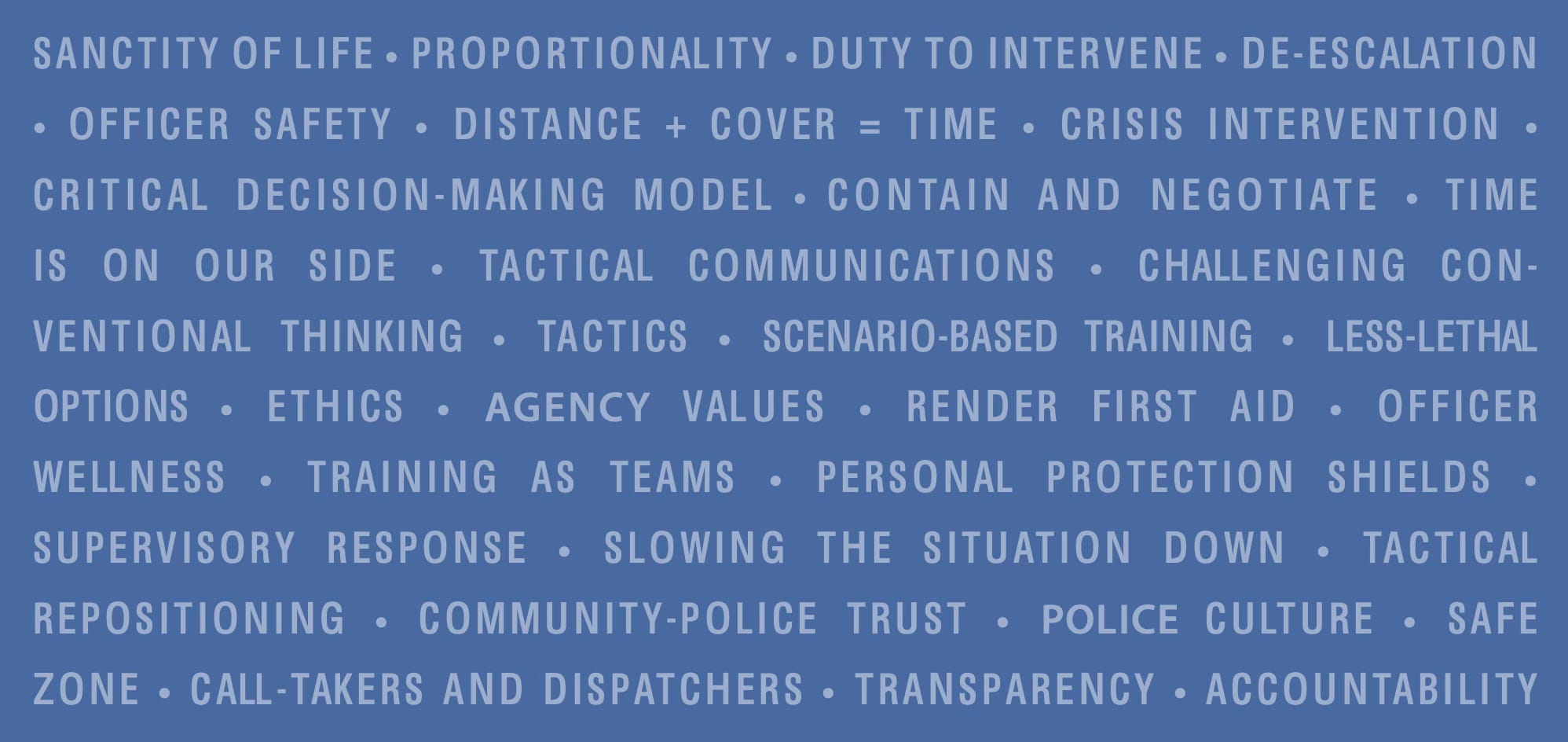
Amid the chaos of 2020, media and activists, and law enforcement leaders quickly went from de-escalation as a tool to be used under certain conditions to a mandate to be the priority regardless of what the officer was facing.
In 2022, over 100 million in funding for de-escalation turned the PERF Guiding Principles from a document of fancy words into PERF’s own de-escalation training, Integrating Communications, Assessment, and Tactics (ICAT), which was heavily influenced by field research conducted with the Scottish Police, where the majority do not carry firearms and homicides with guns are around 0 each year.
Without any evidence of safety, de-escalation became institutionalized in every state and virtually every law enforcement agency.
Two Sides of The Coin
The appeal was visceral and immediate. Officers should communicate better. Crises can often be resolved without force. De-escalation sounds like it should work. Major departments, including the NYPD, adopted ICAT. States began mandating de-escalation training and policy. Officers were fired and even prosecuted for “not de-escalating,” but there was something missing.
The evidence of it working.
ICAT was already at full throttle when Dr. Robin Engel and her team conducted a multidisciplinary, systematic literature review examining 64 de-escalation training evaluations over a 40-year period, primarily in the fields of nursing and psychiatry. As I mentioned earlier, de-escalation is not new, and multiple professions, including law enforcement, have been using it as a tool for decades.
Despite widespread promotion and proliferation of de-escalation trainings, the study concluded that there was no empirical evidence that de-escalation actually de-escalated. In fact, just like D.A.R.E., some studies have shown the opposite effect.
The Louisville Study: The House of Cards
With 40 years of review, including numerous de-escalation models not working, what were the chances that a PERF De-escalation Model based on law enforcement in another country with a violent rate seven times lower than America would be the first to be proven true?
In 2022, Dr. Robin Engel led the first study, analyzing the effectiveness of ICAT. It was funded by Arnold Ventures, which has reportedly spent a billion dollars on police reform research and implementation.

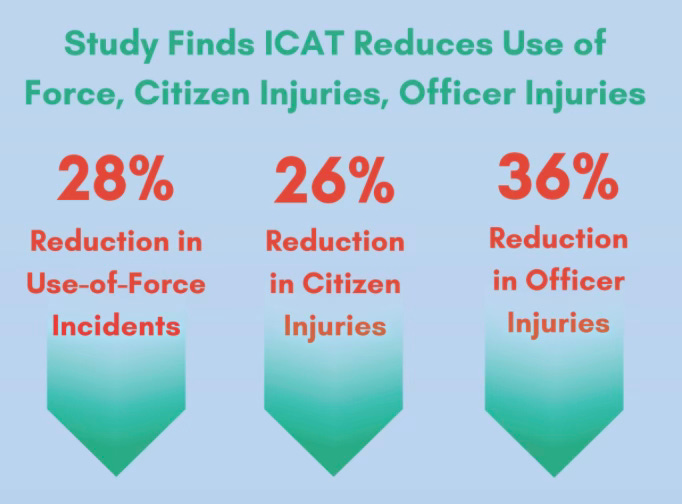
Using a stepped-wedge randomized controlled trial design, the study reported a 28 percent reduction in use-of-force incidents, a 26 percent reduction in citizen injuries, and a 36 percent reduction in officer injuries following ICAT training.
These are striking numbers and continue to be cited extensively in media coverage, policy advocacy, and promotion of ICAT. They became the empirical backbone of a training movement that has now touched hundreds of thousands of officers across the United States.
But is it that simple?
After decades of no evidence, did law enforcement, and more importantly, PERF, figure out how to reduce the use of force and officer injury through de-escalation?
To the researchers’ credit, they warned about the widespread use of the study findings:
Finally, regarding the generalizability of study findings, we remind the field that this is one study, based on one de-escalation training, implemented within one police agency.
The study period also overlapped with the onset of COVID-19 in early 2020, which the researchers themselves acknowledged as a potential confound, as pandemic conditions dramatically altered the nature, volume, and type of police-citizen encounters across every department in the country, with movement restrictions, lockdowns, and reduced street activity suppressing the kinds of volatile encounters where force is most likely to occur. Critically, use-of-force numbers in Louisville were already on a downward trend before ICAT training began, meaning the study could not cleanly establish that the training, rather than pre-existing trends, pandemic suppression effects, or the chilling effect of DOJ scrutiny and national media attention, was the actual causal mechanism behind the reductions.
In 2023, the Department of Justice released a scathing 90-page report based on the same time period as the study, where they said that LMPD had engaged in a pattern or practice of conduct that deprived people of their rights under the Constitution and federal law, including excessive force, searches based on invalid warrants, and unlawful traffic and pedestrian stops.
The same agency, during the same time period, formed the entire evidentiary foundation for ICAT’s national expansion. The idea that this department’s use-of-force statistics during a period of DOJ investigation, national protests, and extraordinary institutional pressure represent a reliable, generalizable measure of ICAT’s effectiveness strains credibility beyond any reasonable scientific standard.
Replication is universally recognized as essential to scientific validation. The principle that a finding should be independently reproducible before being treated as established knowledge is foundational to the scientific method across all empirical disciplines, and to date, this has not happened. The same ICAT training has been evaluated in other jurisdictions and has shown no evidence of reduced force, including de-escalation evaluation studies from Arizona, New Jersey, Indiana, North Carolina, Ohio, and Virginia, which found no effect after training.
The Train Steaming Ahead
The influence that PERF and de-escalation have on the profession can not be overstated. With a study showing a reduction in use of force, most leaders couldn’t say no if they wanted to, and the research is blasted everywhere, for all to see and for anyone who dares question it to be shunned.
I have no issues with Dr. Engel. In fact, I’ve met her, and I like her, but the idea that a single study should serve as definitive evidence for full adoption is not science. Without replication, one outlier study shouldn’t be used for much of anything, but there are millions in play here, and I doubt many will question it.
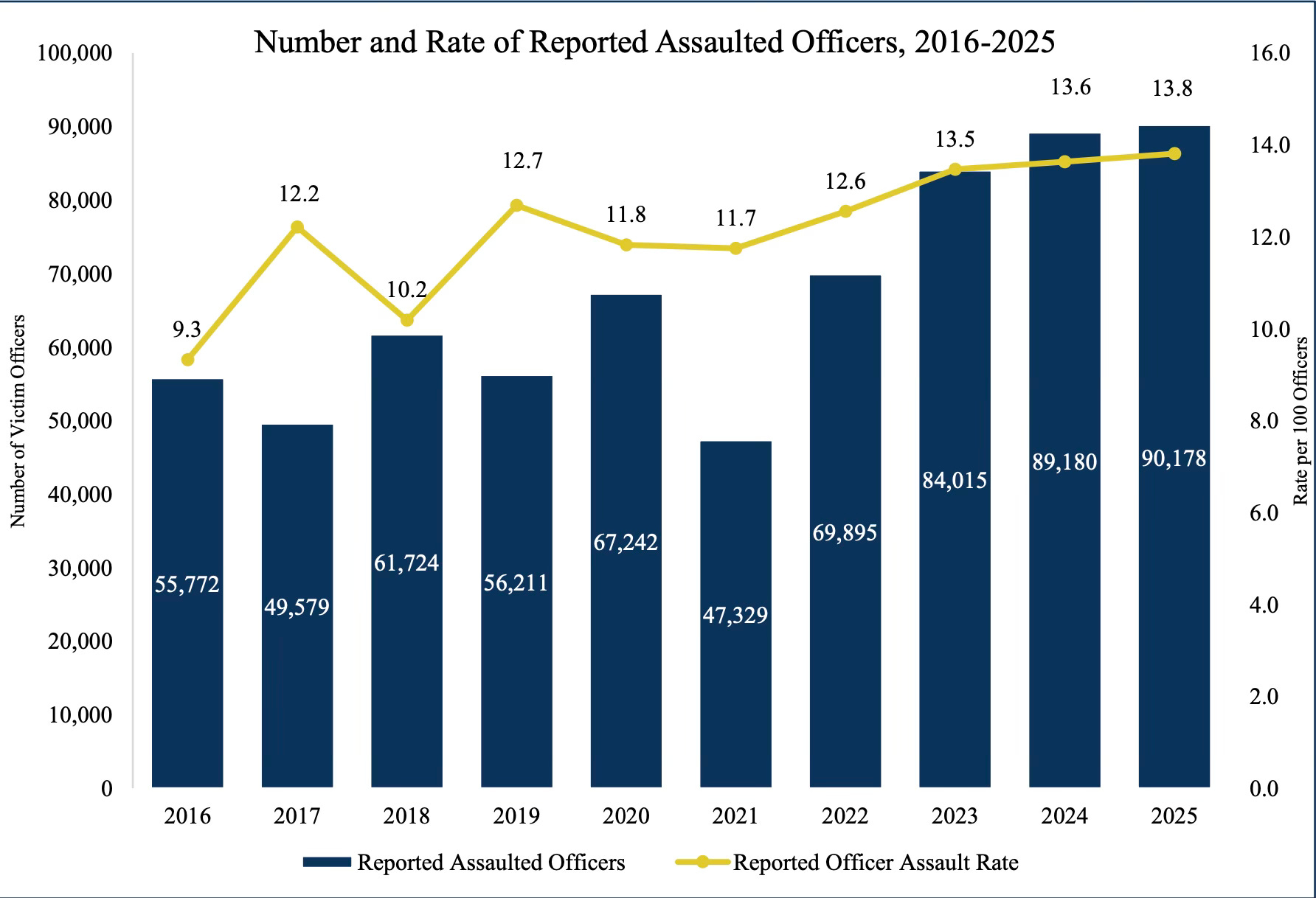
Frankly, I have other things to do, but when I saw an 80% increase in officer assaults over the last decade, including an annual increase every year since 2019 and an all-time record in 2025, I began looking for a root cause and a solution.
I call that solution FOCUS, and that is based on numerous studies, including the largest study of its kind in law enforcement. Regarding the root cause, I am still researching, but what I’m finding is concerning, and I will discuss it in the next article. But consider this:
What if we are training officers to die?
What if our own leaders have adopted a methodology, backed by progressive funding and a single study, that has spiked officer injuries and use of force throughout the country?
Just last month, the National Policing Institute released a study after every New Jersey officer (33,000) went through ICAT. The study covered three years of post data after training, showing a 9.5% increase in use of force. Oddly enough, the study said that officer assault or injury did not decrease but failed to mention if it increased. With an increase in force, there is no doubt it went up.
NYPD completed ICAT in 2023, and in 2024, the agency had a record-high use of force, with officer assaults rising 40% in the year following the training.
And there is more…a lot more that I will discuss in future articles.
What Honest Scrutiny Requires
None of this is an argument against de-escalation. In fact, it was a good idea and practice long before your local activists and millions in public and private money started supporting it. There are sound theoretical and practical reasons to believe that communication skills, tactical patience, and crisis response training can improve officer decision-making (in some situations). The problem is not the concept; the problem is the leap from concept to mandatory national mandates without the evidence to support it.
We saw this with D.A.R.E., and more kids died.
What if more cops are being hurt and killed today by the very concepts we are mandating them to do, regardless of the circumstances they are facing?
Dr. Travis Yates retired as a commander with a large municipal police department after 30 years of service. He is the author of “The Courageous Police Leader: A Survival Guide for Combating Cowards, Chaos & Lies.” His risk management and leadership seminars have been taught to thousands of professionals worldwide. He is a graduate of the FBI National Academy with a Doctorate Degree in Strategic Leadership and the founder of FOCUS, the first research based framework designed to keep officers alive before the threat is identified.