

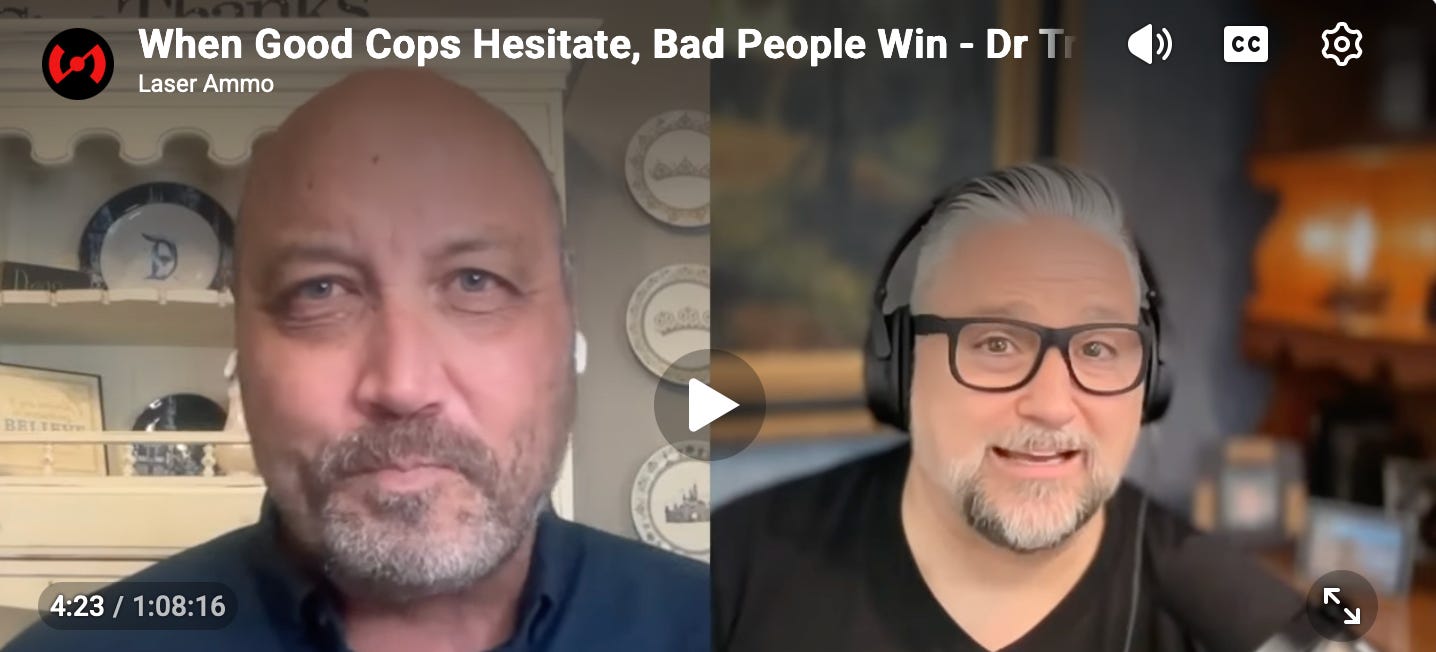
I recently spoke in detail with Terry Vaughn from Laser Ammo about the record increase in officer assaults and the findings of our research on what occurs just before violence against law enforcement.
It’s an important conversation, and I hope you can listen and pass it along.
I have summarized our conversation below, and I want to point to an important training date coming up the day after the IACP Conference in Florida. Our good friend Roland Clee is working hard to bring FOCUS Training to the state, and this event will be special. If you know anyone who will be at IACP, please consider sending them the information.
Key Takeaways
Noncompliance appeared before shootings or shot-at incidents in 95% of the reviewed cases.
De-escalation is a useful tactic, but it cannot be the mandatory response to every threat.
FOCUS teaches officers to recognize behavioral clusters that may signal imminent violence.
Early, proportionate action can reduce an attacker’s opportunity and prevent greater force later.
The Bigger Problem Is Leadership, Not Just Staffing
Recruiting, retention, morale, officer safety, public trust, are operational effectiveness are not separate problems. They are connected symptoms of a leadership failure that has been building for years.
Departments are struggling to recruit. Experienced officers leave. New officers leave at an alarming rate, with 63% of people entering law enforcement leaving within five years. Major agencies are operating far below authorized staffing, then filling the gap with overtime, fatigue, and burned-out people.
That is not sustainable. It also creates a vicious cycle. Understaffing creates exhaustion. Exhaustion affects performance. More difficult encounters create more scrutiny, more stress, and more reasons for good people to walk away.
Officers do not expect perfection from leaders. They expect support, structure, clear policy, and the confidence that their agency will not abandon them for making a reasonable decision in a rapidly unfolding situation.
Ultimately, leaders need to look officers in the eye and say, “Follow your training. Follow your policy. I’ve got your back.”
Why Politics Has Made the Job Harder
Law enforcement leadership became overly focused on political survival rather than the core mission of reducing crime and protecting communities. Chiefs often serve at the will of mayors, city councils, and political constituencies. That can create a leadership culture built around avoiding controversy rather than supporting sound policing.
The end result is fear that flows downhill. A chief afraid of political backlash creates command staff afraid of liability. That creates supervisors afraid to support officers. Eventually, the officer on the street becomes afraid to make the decision that may be necessary.
And the public suffers when that happens. Safe neighborhoods are not built through slogans, public relations stunts, or political talking points. They are built through competent leadership, adequate staffing, sound training, and officers who are equipped to handle dangerous people decisively and lawfully.
De-Escalation Is a Tool, Not a Mandate
I support de-escalation, full stop. Good cops have used it for decades. The problem begins when agencies treat de-escalation as the required response in every incident, regardless of context, threat level, or the behavior right in front of the officer.
It takes two people to de-escalate. An officer cannot verbally de-escalate someone who is committed to attacking, running over, stabbing, or shooting them, and research clearly showed that violent intent is not stopped by nice words or bargaining.
Officers often make split-second decisions under uncertain and dangerous circumstances. Cases such as Graham v. Connor recognize that reasonableness must be judged based on what the officer knew at the time, not through calm hindsight after everything is over.
Yet officers are often trained or pressured to wait longer, talk longer, and seek certainty before acting. That is a dangerous standard in an environment where waiting to see the weapon may leave no time to respond.
“When violent people are in front of you and you do not act decisively, violent people do what violent people do.”
The cost of hesitation is deadly.
The hesitation observed in the research is usually not a failure to recognize danger. Officers often recognize the cues. Their words reveal it. They ask questions such as whether the person has a gun or whether someone else is inside, even when their intuition has already registered the risk.
The real problem is that they may fear being fired, investigated, prosecuted, or turned into the next viral clip. So they wait for certainty.
But certainty in a violent encounter often comes too late.
FOCUS: Field Observable Cues for Unknown Situations
FOCUS (Field Observable Cues for Unknown Situations) was developed to give officers a research-informed framework for identifying imminent threats.
Other professions already use validated real-time violence-risk systems. Healthcare workers, emergency personnel, corrections staff, and clinicians receive guidance on behavior that may predict an immediate assault. Law enforcement, despite routinely facing unknown and dangerous situations, has lacked a comparable evidence-based system focused on the moments just before violence occurs.
Behavioral threat management has substantial value, but it often examines risk over weeks, months, or years. A patrol officer may have seconds.
FOCUS is designed for that short window. It gives officers a shared vocabulary for what they see, why it matters, and how to explain their decisions afterward to supervisors, prosecutors, and others who were not there during the encounter.
The FOCUS Risk Index is not meant to have officers doing math in the middle of a crisis. It is meant to help build recognition, confidence, and post-incident articulation.
The Key Behavioral Cues Yates Highlights
Dozens of potential pre-attack indicators exist, but training must avoid overwhelming officers with endless checklists. The goal is to focus attention on the behaviors that matter most and to assess them in context.
1. Noncompliance
Noncompliance is the biggest low-hanging fruit. In the review of hundreds of videos involving officers who were shot or shot at, officers had encountered noncompliance before the shooting in 95% of cases.
Noncompliance means an officer gives a lawful direction and the person refuses, delays, ignores it, or does the opposite.
That alone does not mean someone must be violently restrained. Context matters. But officers should not treat meaningful noncompliance as though they simply need to repeat the order more politely. It is information. It should affect the officer’s assessment of risk, position, distance, communication, and options.
2. The nature of the call
Call type matters. The incidents in the research overwhelmingly involved tactical calls such as domestic violence, robbery in progress, or reports of a person with a gun.
A felony-in-progress call is not a routine report call. A person suspected of an armed robbery should not be approached with the casual mindset that everything will probably be fine. The circumstances should shape the tactics from the start.
3. Declarations
Sometimes people tell officers what they are about to do, even if they do not state it in plain language. These statements are called declarations.
Examples include:
“You’re not arresting me tonight.”
“I’m not going to jail.”
Statements that signal refusal, finality, or a willingness to escalate.
Suspects made concerning declarations in roughly 28% of the shooting and shot-at cases examined. These are not merely rude comments to dismiss. In context, they can signal that a decision has already been made.
4. Concealed hands
Hands matter because hands access weapons. Concealed hands were a recurring cue, appearing in 53% of the cases in the review.
That does not mean every concealed hand is a weapon. It means officers must pay attention, particularly when concealed hands combine with noncompliance, a high-risk call, verbal declarations, unusual movement, or a suspect changing body position.
5. Walking away and intentional movement
One of the more surprising findings is that in 31% of the reviewed cases, the suspect was walking away before shooting the officer.
Walking away can conceal the hands near the front waistband or pocket. It can also lure an officer into relaxing, closing distance, or reaching toward the suspect without accounting for how quickly the person can turn and access a weapon.
Not every person walking away is an imminent attacker. The point is that when walking away appears as part of a cluster of concerning behavior, it may create an opportunity for violence that officers cannot afford to ignore.
Look for Clusters, Not Isolated Gestures
FOCUS is not about overreacting to one glance, one fidget, or one awkward movement. People look around. People are nervous. People have disabilities, communication issues, and all kinds of reasons to behave imperfectly.
The answer is context and clusters.
Officers who were shot or shot at encountered an average of 4.8 observable behaviors before violence occurred. In incidents where officers used lower-level force early and prevented more serious violence, the average was 1.6 behaviors.
That difference matters. Waiting through four or five warning signs can give an attacker the opportunity they need. Recognizing a developing cluster and taking an early, proportionate action can interrupt the attack cycle before it reaches deadly force.
That may mean creating distance, moving to a more advantageous position, securing hands, using handcuffs as an officer-safety measure where lawful, directing the person to sit or turn around, or calling for additional resources. The appropriate response depends on the totality of circumstances and agency policy.
Early Action Can Prevent Greater Force Later
One of the most important points is that early, lower-level intervention may prevent higher levels of force later.
If a person has intent, capability, and opportunity, officers cannot necessarily change the person’s intent or capability in the moment. What they can often affect is opportunity.
Creating distance, controlling hands, changing positioning, and acting before the person can access a weapon may remove the opportunity to attack. That is not the opposite of de-escalation. In many cases, it is de-escalation because it prevents a more violent outcome.
Focus Training Is About Better Decisions Before the Fight
Firearms skill matters. Fitness matters. Tactics matter. But none of those matter as much as recognizing what is happening early enough to make a good decision.
You cannot arrest your way out of a recognition problem. You cannot recruit your way out of a leadership problem. And you cannot train your way out of a culture that teaches officers to ignore the danger they can plainly see.
FOCUS training helps officers build the recognition, language, and decision-making confidence needed for unknown situations. It is about understanding behavior before the fight starts, not merely explaining force after the fact.
If you are a law enforcement leader, trainer, supervisor, or officer who wants to improve threat recognition before the moment goes bad, make FOCUS training a priority. Learn about upcoming classes and the developing research at FOCUS Certified. The goal is simple: recognize danger sooner, take appropriate action earlier, and give officers a better chance to go home.
Support Has to Be Real
The final challenge is not complicated. Leaders need to become self-aware enough to face what is happening in the profession. They need to stop pretending that staffing shortages, rising assaults, fatigue, low morale, and officer hesitation are isolated issues.
Start with the basics. Support officers who follow their training and policy. Train them to recognize behavioral danger cues. Give them the tools to explain their decisions. Build a culture where good judgment is backed up, not second-guessed into paralysis.
Because when good cops hesitate, bad people win.
Dr. Travis Yates retired as a commander with a large municipal police department after 30 years of service. He is the author of “The Courageous Police Leader: A Survival Guide for Combating Cowards, Chaos & Lies.” He has taught his risk management and leadership seminars to thousands of professionals worldwide. He is a graduate of the FBI National Academy with a doctoral degree in Strategic Leadership and the founder of FOCUS, the first research-based framework designed to keep officers alive before the threat is identified.
Great job to you and Terry Vaughn on addressing this vital topic. FOCUS training will reduce officer and suspect injuries and save lives in both groups. I'm looking forward to the Florida training in October just after IACP in Greater Orlando (Decision Tactical in Sanford, Florida).
Register here now. Tickets are selling. This event will sell out.
https://commandstaffconsulting.com/events/focus-training-28/