


I hate rabbit holes because when I find them, I have a tough time pulling myself out of them, and that’s what happened a few months ago when I discovered that no one in law enforcement leadership seemed to be talking about record-high levels of officer assaults.
The silence was even more deafening when I seemingly discovered the cause had become the sacred cow of so many leaders.
De-Escalation
It didn’t take long to find a direct correlation with those assaults when agencies implemented restrictive use-of-force policies and mandatory de-escalation. The insane part is that not only did more officers get assaulted and injured, but the use of force also increased dramatically in those agencies.
Could this be true?
Could an entire profession, led by organizations like PERF and their sheep followers, actually endorse a practice that not only harms more cops but also citizens? It’s so outrageous that I didn’t want to believe it, which is likely why no one has ever bothered to evaluate what has become a standard practice in law enforcement.
Think about it. De-escalation and law enforcement have become like bread and butter. You can’t have one without the other, and police chiefs are doing mental backflips to make sure they are doing their part.
But no one has actually asked whether it works? A few have tried with no avail.
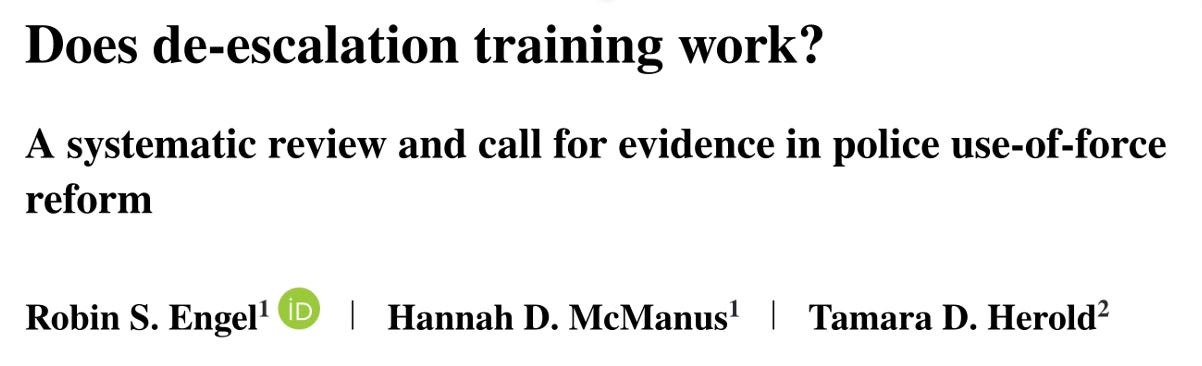
To save you some time, here is the money quote in this research:
“Researchers have not been able to address these concerns adequately because, similar to most other police training curricula, de-escalation training has not been subjected to rigorous scientific testing.”
Where Is The Evidence?
Think about it. If de-escalation were so significant for our profession and for reducing the use of force and officer injury, wouldn’t we want to promote its study and research?
To be clear, some excellent researchers have done some work on it, and I’m not saying that de-escalation should be thrown out of the profession, but there is no doubt that something is seriously wrong with the current deployment of this practice.
If any new policy or training increased the use of force and led to more officer/civilian injuries, we would immediately re-evaluate our efforts unless the topic is de-escalation. The science is settled, which is the opposite of what science is.
In the case of de-escalation, that would mean no science equals settled science.
I was so troubled by this nonsense that I decided to dig a little further and discovered things like the internet and police body cameras.
Since turning 50, I’ve been on a quest to preserve as many brain cells as possible, so I don’t know anyone at PERF, but if you do, please pass along the news that our de-escalation efforts can be easily evaluated using this newfound discovery.
De-Escalation Good…Practice Bad
If de-escalation was the key to success, wouldn’t it be easy to see? Wouldn’t law enforcement leaders be promoting how cool they were by releasing successful de-escalation on video?
Maybe it’s out there, but after viewing over 500 body camera videos of officers being shot from across the country, I’ll tell you what isn’t out there.
De-escalation working to de-escalate violence.
I’m early into this research, but I have found three common denominators with law enforcement being shot at, shot, and killed.
Call Type: 91% involved calls where a high level of tactics were required (shots fired, wanted subject, domestic violence, etc.).
Non-Compliance: 100% involved some sort of non-compliance by the suspect.
Within these top two denominators, a significant portion involved police officers knowing the situation was dangerous, receiving non-compliance, and then attempting to address both by de-escalation.
I haven’t found successful de-escalation yet.
To give you some context, in the video below and before the encounter, the officers knew that this subject had just committed a robbery at a grocery store with a gun.
This is not the fault of the officers, and they are alive today despite the policy they work under.
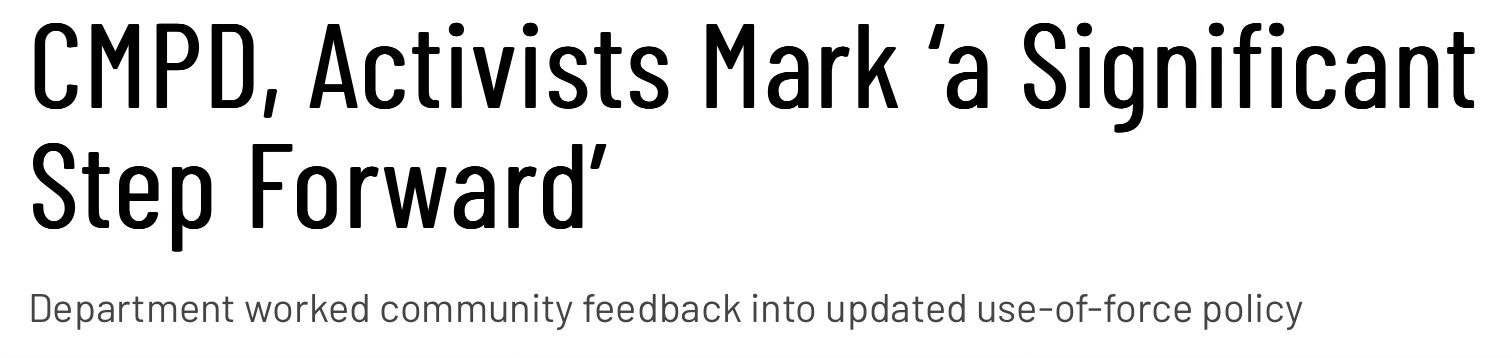
This “significant step forward” occurred in 2019. Considering the agency encountered 10,700 armed suspects that year with just four deadly force incidents, no doubt the outrage and policy changes were needed.
Here are some highlights of the policy:
The old “use of force” policy was rewritten into a 14-page “Response to Resistance” with de-escalation, verbal warning, dialogue, and commands having a dedicated section within that policy.
The policy stresses that force may be reasonable under the legal standard of Graham v. Connor, but still be deemed out of policy.
De-escalation should be “the goal in every incident,” and not just an optional tactic while “sanctity of life” is always the starting point.
I could discuss more, but I’ll end with some of the training the officers receive. The family members of violent criminals shot by police are embedded in recruit training to “humanize” the stakes of using deadly force.
With all of that in mind, it’s no wonder those officers treated this felony suspect with a gun like an ole friend from high school?
What Are We Doing?
Law enforcement leaders have lost their way. What you see above is not an anomaly; it’s the norm.
I’ve been training in the leadership space for years, and all I hear is accountability, character, integrity, and a host of other clichés we cling to after listening to far too many John Maxwell talks.
But who are we?
Are we really leaders who will continue to cling to feel-good words and dangerous policies that are getting our officers killed?
I’ve reached out to several well-respected leaders in recent weeks because I want to be told something different. I don’t believe what my own eyes are showing me, and I’m not being told what I want to hear.
These leaders were among the highest-ranking in our profession. They were in the committee meetings and behind the scenes of the organizations, pulling us into this chaos, and they all told me the same thing:
THEY KNOW THEY ARE SACRIFICING THE LIVES OF COPS.
Of course they do. They are reviewing the same videos that I am, on a micro level, within their agency.
They see what I see and what you know.
They just don’t care enough to do anything about it.
Dr. Travis Yates retired as a commander with a large municipal police department after 30 years of service. He is the author of “The Courageous Police Leader: A Survival Guide for Combating Cowards, Chaos & Lies.” His risk management and leadership seminars have been taught to thousands of professionals across the world. He is a graduate of the FBI National Academy with a Doctorate Degree in Strategic Leadership and the CEO of the Courageous Police Leadership Alliance.
We (the police) have always sought to "de-escalate" even if we did not call it that. We just didn't sacrifice officer safety first. None of us run Code-3 with the thought, "I'm going to shoot this guy as soon as I arrive" but true warriors (now the exception) should always be ready to exercise lawful use of force as the situation demands. I've been saying for years now that this "new world" of law enforcement gets cops killed and re-victimizes victims. God help us. Well done brother.
Powerful and necessary! It takes courage to stand for truth!