

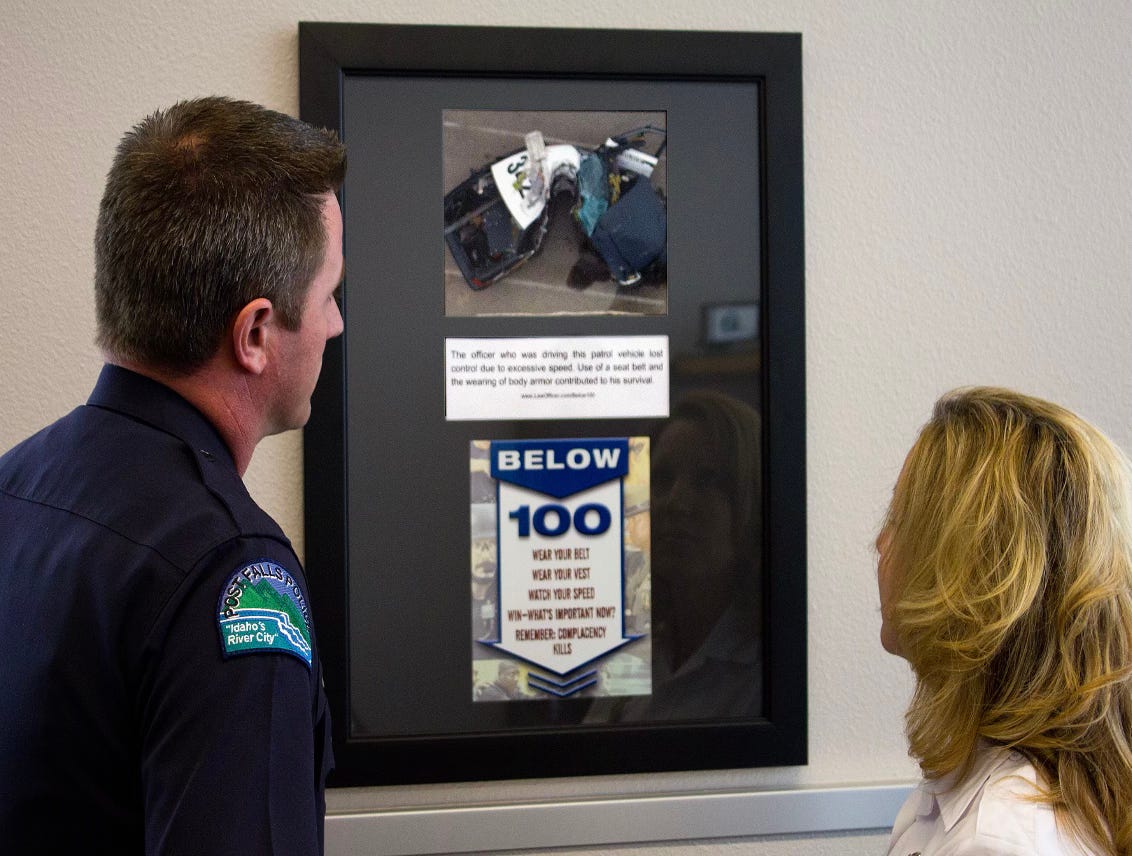
Law enforcement finished 2025 with a reduction in line-of-duty deaths not seen since 1897. I’ve seen several discussions of the 97 line-of-duty deaths, and it’s essential to examine what this means and how leaders may have or have not played a role.
Police One
I spent the first decade of my career focused on EVOC-related issues and had the blessing to take that knowledge to Police One. From 2005 to 2015, I wrote an article on the topic every month. While the issues are commonly known today, they weren’t when I started. P-1 placed a lot of emphasis on the issue when few others would. During that decade, I discovered some crazy things.
I discovered years when trees killed cops more than bullets (single car crashes).
More than half of cops killed in their cars weren’t wearing seatbelts.
Over a 20-year period, cars killed cops more than felonious attacks.
Doug Wylie was my editor for most of that time, and he had the courage to publish this information when no one else seemed to care. Doug’s leadership, with the support of P-1, brought this issue to the forefront for millions, and I found myself representing that message at countless conferences. While we are still seeing some of the problems discovered decades ago, there is no question that it has been reduced, and in the last decade, vehicles have no longer been the leading cause of death among the profession.
Below 100
If you are in law enforcement, it’s hard to think about 97 line-of-duty deaths without considering the Below 100 Training program, designed to reduce line-of-duty deaths to below 100 a year. Admittedly, I’m closer to this than most, and it’s a story of courageous and cowardly leadership.
I knew from my work at P-1 that line-of-duty deaths could be below 100 if we corrected what we controlled, and much of that was behind the wheel. I called it “low hanging fruit” and my agency implemented a course designed to do just that. We saw a dramatic reduction in injuries and collisions, so when the National Law Enforcement Memorial contacted me to help reduce line-of-duty deaths, I jumped at the opportunity. In 2009, I met several members of their Board of Directors in Chicago and shared my idea with them.
A train-the-trainer course designed to reduce line-of-duty deaths below 100.
I told them it wouldn’t cost them anything, and all I would need is the power of their reach to spread the message. I had trainers lined up and ready to go. They told me they were busy with upcoming events and hoped I would participate in an “annual report” that would discuss the issue.
I can’t repeat here what I told them, but clearly, a PDF wasn’t going to stop the senseless tragedies occurring weekly in the profession. I do want to point out that the then Executive Director, Craig Floyd, was not present at the meeting and, to my knowledge, has no idea what occurred. I have known Craig for years, and he has been nothing but superb for the profession; that one meeting is in no way meant to diminish the overall work of the NLEOMF.
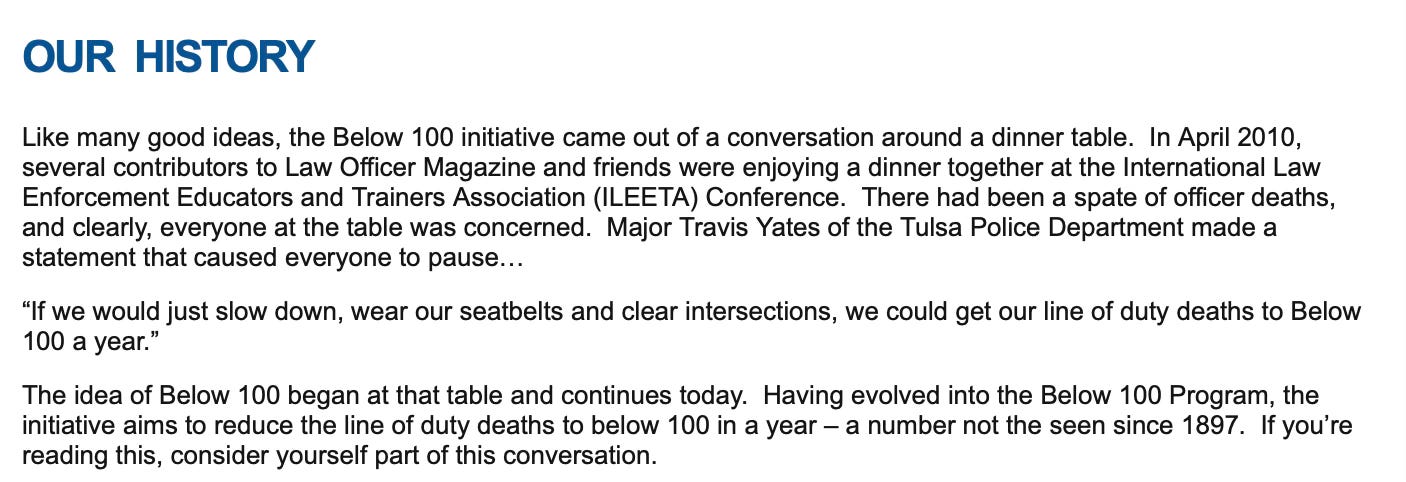
One year later, I found myself in Chicago again at the ILEETA Conference and was invited to a dinner hosted by Law Officer Magazine. Dale Stockton was the editor and was a legend in the law enforcement publishing industry, and at some point in our discussions, I mentioned the idea of Below 100. The table of accomplished trainers and writers was nice to hear me out, and that’s where I thought it stopped. A few weeks later, Dale called me and asked if I wanted to move forward on the Below 100 Training program. After I stopped him in mid-sentence and said yes, he asked where we should do the first class. I had just taught in Charlotte, so I told him Let’s do it there.
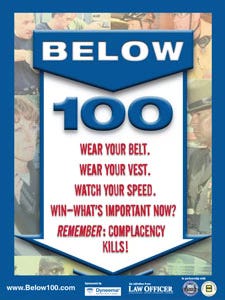
Dale Stockton and Crawford Coates were the driving force behind Law Officer, and they spent the next several weeks promoting the class in the magazine, including this multi-page insert that Dale ran without any advertising support (a bold decision). Honestly, I wasn’t sure it would work. Would cops actually come to a class telling them that the majority of line-of-duty deaths were their own fault?
Over 100 showed up for the first train-the-trainer course, and some came from thousands of miles away.
I would find myself in a classroom with Dale Stockton and Brian Willis countless times over the next few years, and we would provide thousands of trainers with the Below 100 materials and tell them to make change happen.
Below 100 began 15 years ago, but to this day, I still get asked about it. It’s mandated training in over a dozen states, and it’s rare that I walk into a classroom around America and don’t see a poster or a mention of it.
This is because Dale Stockton and Crawford Coates defied any business sense and did it anyway.
Brian Willis already had a tremendous training company, but he volunteered countless hours to join Dale and me for those critical “first-year” classes.
Gordon Graham always has plenty to talk about, but he made it a point to discuss Below 100 in every room he was in.
California Highway Patrol Chief Brent Newman and California POST Executive Director Paul Cappitelli were among the high-profile leaders who not only brought Below 100 into their agencies but also endorsed it nationwide.
Tommy Loftis was one of many trainers who not only took the class but also presented it to thousands.
I was a full-time shift commander at the time, and there was no way I could travel more than a few days a month. Major Julie Harris was my boss at the time, and when she found out about Below 100, she told me to do it. Official agency travel had to come from the top, but Julie knew it wouldn’t work, so she told me to go anyway, make sure I didn’t get paid anything, and if the heat came, she would shield it. It never came until the following year, when my new boss noticed I had been on a “special assignment” for three months. He told me to enjoy the Hilton Points, and that would never happen again. It never would, but the deed was done. We had over 3,000 trainers armed with the message that Below 100 was possible.
2025…A Cautionary Tale
I’ve seen several Below 100 trainers posting about the 2025 milestone, but I am also pleased that they are not taking a victory lap. I do not doubt that law enforcement has changed for the better on these issues, but I continue to have serious concerns.
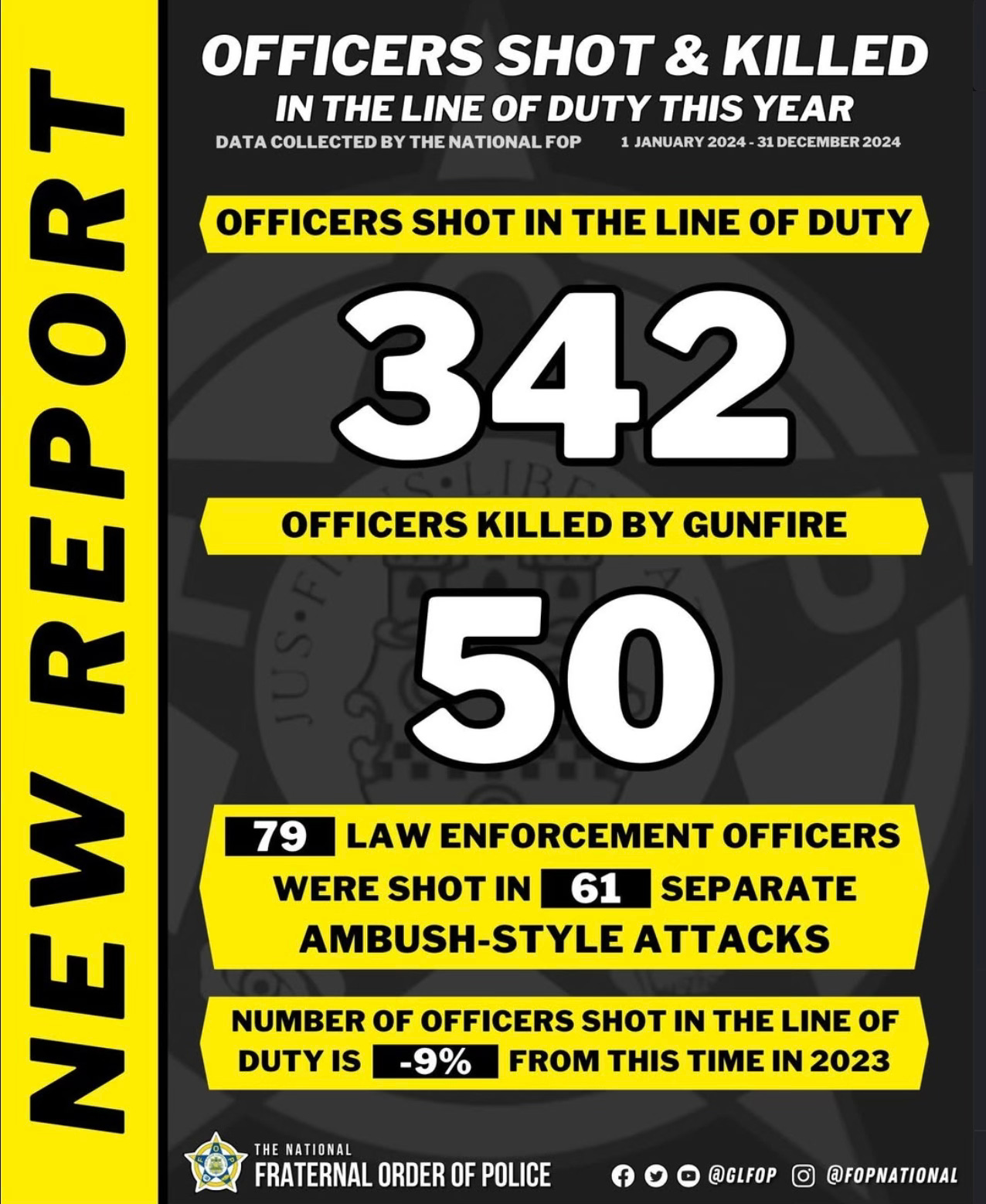
The reduction is primarily because of two factors: driving and disease. Vehicle-related deaths were reduced from 20 (2024) to 11 (2025), while fatalities from COVID-19 and 9/11 went from 28 (2024) to 2 (2025). Felonious deaths by firearm were only slightly reduced (49-43), while 342 officers were shot in the line of duty, along with 61 ambush attacks.
Below 100 has not been just about a class, but also the advances in medical technology, the advent of medically trained personnel behind the badge, and the use of tourniquets to name a few.
A Not So Hidden Enemy
I’ve discussed it here, but the profession is being dealt with policy and training that is opening the door to violence against the profession as we have never seen. From 2020 to 2024, law enforcement saw an increase in assaults each year, with 2024 being a record year for officer assaults. We have never seen a period in time where so many cops were being attacked.
It may not be showing up in the LODD data, but it’s in the background, waiting to pounce. In the coming months, I will be announcing a program that will significantly reduce assaults and injuries against law enforcement. Like Below 100, 15 years ago, it won’t be adopted by the masses, but some will, and they will train others, and they will keep training others, and they will believe and it will happen.
Dr. Travis Yates retired as a commander with a large municipal police department after 30 years of service. He is the author of “The Courageous Police Leader: A Survival Guide for Combating Cowards, Chaos & Lies.” His risk management and leadership seminars have been taught to thousands of professionals worldwide. He is a graduate of the FBI National Academy with a Doctorate Degree in Strategic Leadership and the CEO of the Courageous Police Leadership Alliance.
I am honored to have played a part in this journey. Congratulations to you and the entire group who have worked tirelessly for this moment!
Keep getting after it Travis. There is much under our control when it comes to the safety of our profession. Accountability, leading with integrity and passion are great places to start!!! All the best for a peaceful, productive, and impactful New Year, John